


Not a Day Trip Boat Tour in Cappadocia, but a Valley Hiking Tour: Route and Visit Schedule
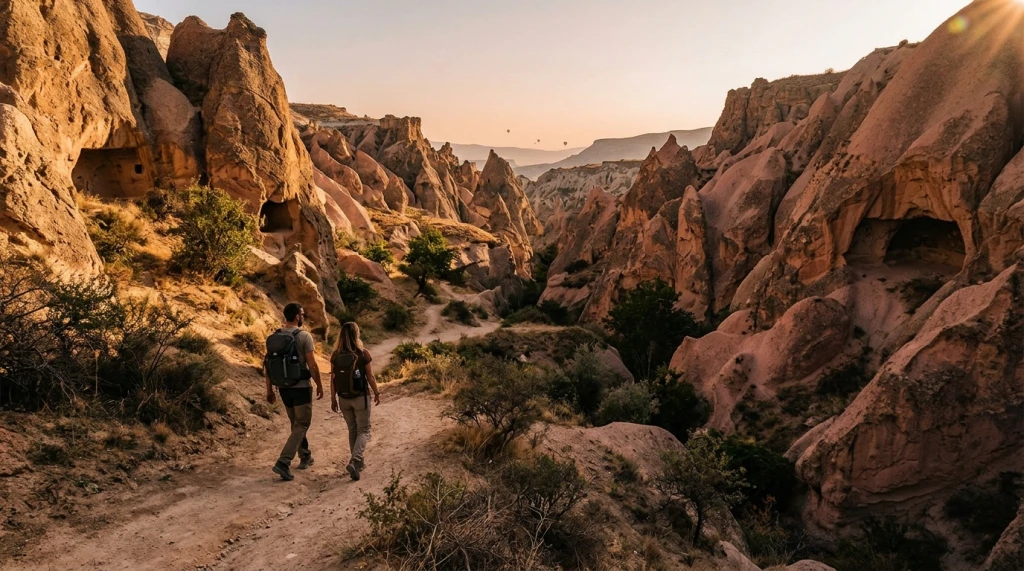
Valley hikes in Cappadocia offer a view of the region from ground level, at eye height with the land and its people. Rock-cut churches, pigeon houses, vineyards and traces of villages abandoned centuries ago are all on a scale that only becomes apparent on foot. These routes do not require long physical preparation, but some are rocky and sloped; knowing what to prepare for before you set out will help you make better use of the day.
Güvercinlik Valley: The Right Route for Beginners
Güvercinlik Valley begins just below Uçhisar Castle and stretches about 3.5 kilometers toward Göreme. The walking surface is largely flat, there are no steep climbs, and the trail markers along the dirt path are kept in good order. The rock niches that gave the valley its name, which house pigeon nests, appear frequently in the first half hour; they were carved during the Ottoman period to collect pigeon droppings. The walk from Uçhisar to Göreme usually takes 1.5 to 2 hours. To reach the starting point, simply follow the signs around the entrance to Uçhisar Castle. It is also considered suitable for families with children and older walkers, though sneakers or walking shoes are recommended.
Kızılçukur Valley: Changing Light and Color
Kızılçukur Valley takes its name from the red-orange rock texture caused by the high concentration of iron oxide. Stretching between Çavuşin and Ortahisar, the valley reaches its most intense colors when the afternoon sun begins to lower; so being there between 3:00 and 5:00 p.m., rather than in the morning, is an advantage for both photography and walking comfort. The route starting from the Çavuşin exit takes about 2 hours one way and ends at the Ortahisar entrance. Because the peaks and outcrops are rocky, care is needed on the narrow paths that descend into the valley. The route passes through vineyard areas, and during the harvest season (September–October) some sections may be temporarily closed.
Ihlara Valley: Not a Half Day, but a Full Day
In terms of both physical and historical scale, Ihlara is a different category from Cappadocia's other valleys. Walking the entire valley, which stretches about 14 kilometers along the Melendiz River, may not be possible in one day; most visitors choose the middle section of 7–8 kilometers from the Ihlara village entrance to Belisırma village, which takes about 3–3.5 hours. The rock churches inside the valley, especially Ağaçaltı Church and Kokar Church, contain frescoes from the Byzantine period. At the entrance there is a steep descent of more than 400 steps; rather than climbing back the same way, it is more common in practice to arrange a vehicle transfer from Belisırma. Even in summer, the coolest part of the valley is in the shade of the trees; nonetheless, water and snacks should always be carried.
Meskendir Canyon: Less Known but Distinctive
Meskendir Canyon lies near Mustafapaşa, about 7 kilometers from Ürgüp. A small stream flowing through a narrow rock passage makes walking along the canyon floor both refreshing and demanding of attention; since your feet will be on wet ground, waterproof or quick-drying shoes are preferable. The canyon is roughly 2 kilometers long, and a round trip takes 1.5 to 2 hours. Starting the walk early in the day during summer has the advantage of avoiding the heat while also benefiting from the wet ground. This is a point on the route where large tour groups have not yet become very concentrated; it is a suitable choice for travelers who have already seen Güvercinlik or Kızılçukur and are looking for something different.
Seasonal Differences: What to Expect in Each Month
Spring (April–May) and autumn (September–October) are the most balanced periods for valley walks. Temperatures stay in the 15–22 degree range, the ground dries out, and vegetation is lush. In summer (July–August), midday temperatures can reach 35 degrees, so walks that start at 7–8 a.m. are far more comfortable. In winter, snow comes to the region once or twice; valleys such as Ihlara take on a highly visual atmosphere under snow, but snow and ice on rocky paths can cause slipping, so this period is not recommended except for experienced walkers. During the Ramadan Feast and summer holiday periods, valley starting points and parking areas become crowded; weekday morning hours largely avoid this crowding.
Can Multiple Valleys Be Combined?
The Güvercinlik and Kızılçukur valleys can be walked one after the other in a single day. It is possible to start early in the morning from Uçhisar, pass through Güvercinlik Valley and arrive in Göreme, spend the midday in Göreme, then transfer to Çavuşin to enter Kızılçukur and finish at sunset in Ortahisar. This program amounts to roughly 5–6 hours of total walking; it suits an adult of moderate fitness, but if it is done with children or at a slower pace, the midday break in between can be extended. Ihlara is geographically about 50 kilometers from the other valleys, so fitting it into the same day is a strain both in terms of transport and physical fatigue; the best option is to set aside a separate day for it, or include it when you already plan to stay overnight in the region.
Practical Information
- Duration: Half a day (3–4 hours) is sufficient for Güvercinlik or Kızılçukur. Set aside a full day (6–7 hours) for Ihlara.
- Transport: Minibus services run between Göreme, Uçhisar and Ürgüp. The valley starting points are mostly within walking distance of these settlement centers or reachable by a short ride. For Ihlara, there are minibus connections via Aksaray or Güzelyurt.
- Footwear: Sneakers are the minimum; for Meskendir and Ihlara, waterproof or quick-drying trekking shoes are more suitable.
- Water and food: There are no shops inside the valleys. Set out with at least 1.5 liters of water and a small snack.
- Seasonal advice: April–May and September–October are the most balanced periods. For summer walks, starting early in the morning (07:00–08:00) is strongly recommended.
- Things to watch for: Mobile signal may be weak inside the valleys. It helps to download the route to an offline map in advance or note the trail markers at the start.
What to Look at When Deciding
When planning a valley walk in Cappadocia, first answer two questions: How many hours of walking do you want, and is there anyone in the group with physical limitations? Güvercinlik is flat and short, Ihlara is long and involves both descent and ascent, and Kızılçukur is of medium distance but rocky. Take the season into account as well; in July–August the cool shade of Ihlara is an advantage, while the open rocky peaks of Kızılçukur can get quite hot at midday. If photography is your priority, leave Kızılçukur for the afternoon; if you are curious about historical structures, give the morning to Ihlara. A good day plan begins with knowing what the region offers and ends with being able to adapt to conditions.
You can browse the day tours and activities covering this region and choose the one that suits your itinerary.