


Things to Know Before Visiting Pamukkale: Travertines, Hierapolis and Visiting Arrangements
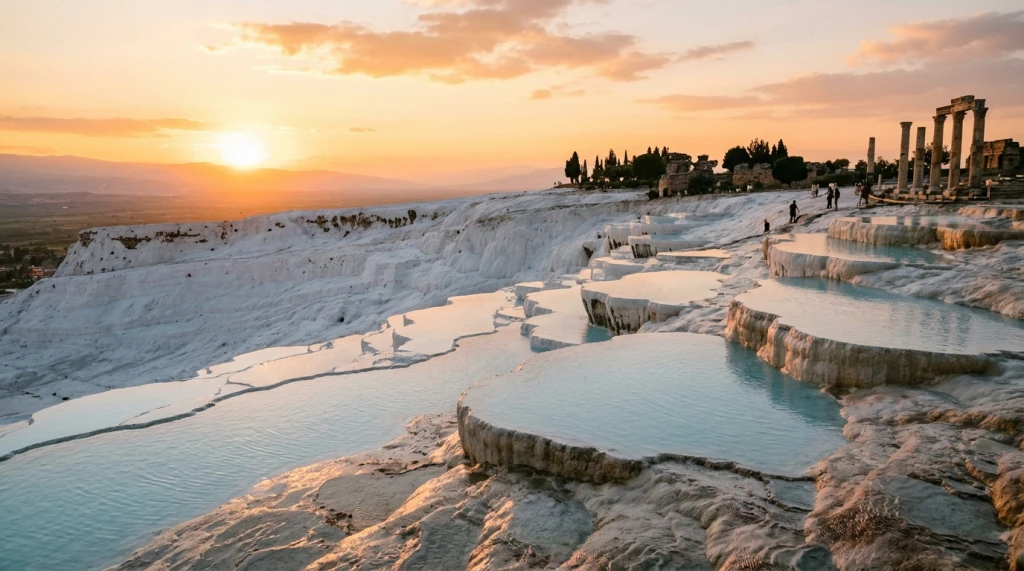
Pamukkale consists of white terraces formed by calcium carbonate deposits, rising just above a small town in Denizli province, and the Roman-Hellenistic city of Hierapolis built on top of these terraces. The two components are not visited separately; the archaeological site entrance covers both, and without a proper plan it becomes difficult to finish one and move on to the other. This guide is written to answer, in order, the questions someone visiting the region for the first time is likely to ask.
Where Pamukkale Is and What You Will See
Pamukkale is located about 20 kilometers from the city center of Denizli. The main feature of the area is the white-cream colored terrace pools, formed over centuries as thermal spring waters deposited limestone. Water collects in these pools, while their surfaces are covered with a hard and slippery lime crust. At the top of the terraces begins the ancient city of Hierapolis, spread over an area of roughly 200 hectares. Here there are several groups of structures, including the theater, necropolis, ancient street, Martyrion structure and the Antique Pool. Spending hours on one while skipping another is easy, so deciding first which one is your priority is a good starting point.
When to Go: The Real Difference Between Seasons
Pamukkale is open all year round, but each season does not offer the same experience. In the summer months, especially July and August, the site experiences heavy visitor traffic; walking on the travertines amid crowds and finding space in the terrace pools becomes difficult. In addition, midday temperatures in the open area can reach 38-40 degrees Celsius and there is very little shade.
April-May and September-October offer more balanced options in terms of both crowds and temperature. During this period the pool water is at sufficient levels, and lighting conditions are more favorable for photography and general comfort. In winter months visitor numbers drop noticeably; some of the terraces may look drier as water flow decreases, but a visit free from crowds becomes possible. If the weather is cool, the site usually remains open.
Entrance Points and How to Move Around the Terraces
The Pamukkale archaeological site has three entrance gates: the South Gate (close to the town, route going up the travertines), the North Gate (close to Hierapolis, route starting from the top) and an alternative entrance from the direction of Karahayıt. The most common choice is to enter through the South Gate, walk up the travertines, visit Hierapolis at the top, and then exit through the North Gate. This route takes about 4-6 hours.
Removing your shoes is mandatory for walking on the travertines; since the limestone surface is slippery, slow steps are necessary. Carrying a plastic bag or a waterproof compartment in your bag prevents your shoes from getting wet while you carry them. Entering the pools is allowed, though this means walking slowly through them rather than swimming. They are not deep, at most knee-high.
Hierapolis: How Much Time to Set Aside for the Ancient City
Hierapolis extends northward from the upper platform where the terraces end. First you encounter the south necropolis (the large Roman-era cemetery), followed by the ancient street, the theater and the Martyrion structure. The theater is particularly well preserved; the reliefs on the stage facade and the seating steps are largely still standing.
The Hierapolis Museum is arranged inside a former Roman bath structure, where statues, architectural fragments and ceramics from the region are displayed. There is no separate visiting fee; it is included in the archaeological site ticket. The Antique Pool, however, is a separately charged section: it offers the opportunity to swim in a thermal pool containing fallen columns from the Roman period. Whether to enter is a personal choice, but visibility of the water can decrease when crowded. Trying to leave Hierapolis without setting aside at least 2.5 hours means missing much of it.
How to Get There: Access Options from Denizli to the Area
The main hub for reaching Pamukkale is Denizli. There are both flight and bus connections to Denizli from Istanbul, Ankara and Izmir. Denizli Çardak Airport is about 65 kilometers from the city center; after transferring from the airport to Denizli, Pamukkale is reached by minibus or dolmuş.
Regular dolmuş services run from the Denizli bus terminal to the town of Pamukkale; the journey takes about 35-45 minutes. If you are coming by private vehicle, there is a parking area near the South Gate. For those who want to combine Pamukkale with Ephesus, Aphrodisias or Salda Lake in the same tour, you can review programs covering the Aegean region among the domestic tour options available. The Aphrodisias and Pamukkale combination in particular is a popular choice among visitors who like to see two ancient sites in a single day.
Who It Suits and Who May Find It Challenging
Pamukkale is partly challenging for visitors with mobility limitations due to the slippery surface and long walking distances. It is possible to drive from the North Gate to a higher point, allowing shorter access to the theater and museum. However, the travertines themselves require attention in terms of ground conditions.
The area is generally suitable for families with children; it is appealing for children who enjoy open air and contact with water. For those arriving unprepared for long distances, an afternoon visit can be exhausting, especially in summer. For photography-focused visitors, the early hours right after sunrise are advantageous in terms of both light and crowds; however, the site does not allow entry before official opening hours.
Practical Planning Information
- Visit duration: The travertines and Hierapolis together need a full day (5-7 hours); the travertines alone need 2-3 hours.
- Best season: April-May and September-October; advantageous in terms of the balance between crowds and temperature.
- Entry arrangement: Entering through the South Gate and leaving through the North Gate is the most common route; if you come by car, there is a shuttle between the gates.
- Footwear: Removal on the travertines is mandatory; non-slip soled slippers or shoes that can be easily taken off are recommended.
- Water and sun protection: The site has no shade; you should not go out in summer with less than 1.5 liters of water.
- Antique Pool: Separately charged; ticket prices should be checked from the current price list at the entrance.
- Photography time: Early mornings and late afternoons are more suitable in terms of light; midday sun washes out the whiteness of the surface.
- Karahayıt: A separate village 5 km from Pamukkale with red-watered thermal springs; it can be included in the same day.
Final Considerations Before Your Visit
Pamukkale is satisfying when expectations are set correctly, and can be disappointing when they are not. If you are going only to look for the blue pools you have seen in photographs: those images partly belong to the past and partly to special shooting conditions. In reality, pool levels and water color change depending on the season and time of day. However, the strange and quiet beauty felt while walking on the white terraces does not resemble a photograph; it is a place that must be experienced. When planning your time, choosing early morning or late afternoon is the most concrete step toward a visit independent of the crowds.