


Things to Know Before Visiting Şanlıurfa: Balıklıgöl, the Historic Bazaar and Visiting Arrangements
Şanlıurfa lies in the southeast of Turkey, on the northern edge of the Mesopotamian plain, a city where several successive civilizations have lived side by side. In this geography, history is not confined behind museum walls; it is still alive in the bazaar, in the courtyards of the caravanserais and in the fabric of the neighborhoods. For someone visiting the city for the first time, the most common question is: is there really anything worth seeing besides Balıklıgöl? The short answer: yes, and Balıklıgöl often ends up somewhere in the middle of that list.
Where Is Şanlıurfa and What Kind of City Is It?
Şanlıurfa is located about 145 kilometers northeast of Gaziantep, 45 kilometers from the Syrian border. With a population approaching 2 million, the city is one of Turkey's youngest provinces in terms of population structure. The historic center is quite dense and pedestrian-oriented; the distance between Balıklıgöl and the Covered Bazaar is less than 10 minutes on foot. The modern parts of the city are clearly separate from its historic core, and most visitors spend their time in the historic center. As one of the important cities of the GAP region, it also serves as a base for nearby sites such as Göbekli Tepe and Harran.
Balıklıgöl and the Dergah Area: The Gap Between Expectation and Reality
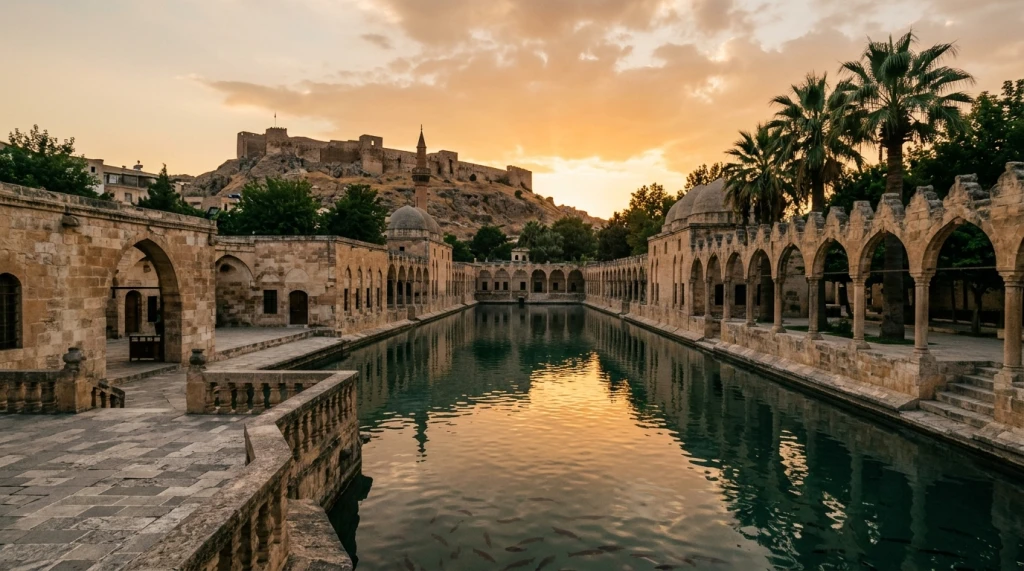
Balıklıgöl is the city's most photographed spot and the first stop for most visitors. The stone walls around the pool, the palm trees and the tea gardens create a lovely atmosphere; touring it in the early morning, before the crowds form, is much more pleasant. The Halil-ür Rahman Mosque on the east bank of the pool and the Ayn-ı Zeliha pool on the opposite side together form a complex, and the walk between them takes 5 minutes. The dergah area covers the wide space surrounding these pools and sees heavy local visitor traffic in the evenings. On weekend evenings finding parking becomes difficult; walking from your hotel or taking a taxi from the city center is more practical.
The Covered Bazaar and Han Streets: The Real Fabric of the City
Just a few narrow streets north of Balıklıgöl, the Covered Bazaar begins. Gümrük Han, Sipahi Han and Kazzaz Han stand side by side in this area; the stone courtyard of Gümrük Han in particular offers visitors a surprisingly beautiful interior space. Copperwork, silk weaving and spice stalls coexist in the bazaar. Most visitors give an hour to Balıklıgöl and 15 minutes to the bazaar, yet doing the opposite is more sensible. Strolling slowly through the bazaar, entering the caravanserai courtyards and chatting briefly with the tradespeople easily fills two hours. The bazaar is open from 9 in the morning until 7 or 8 in the evening; some shops close during Friday noon prayer.
Urfa Castle and Viewpoints
Directly above the dergah area, on the summit of the steep rock, stands Urfa Castle. The ascent is made via stone steps passing through rock-cut recesses; the climb takes about 15 to 20 minutes and is not strenuous. On one of the summit columns is a shrine attributed to Prophet Job (Hz. Eyyub), a small place carefully maintained by visitors. But the real reward is the view: from the castle hill, both Balıklıgöl and the Urfa plain are visible together. The best time for photographs is the afternoon, between about 3 and 4 pm, when the sun begins to shift west. In morning light the castle falls into shadow and the shot is not very effective.
When to Visit Şanlıurfa: The Real Difference Between Seasons
Summers in Şanlıurfa rank among the hottest cities in Turkey; the July-August average can reach 38 to 40 degrees, and walking the streets at midday is genuinely difficult. If you go during this period, keep your activities to the early morning hours of 7 to 9 and the late afternoon hours of 5 to 7 pm, and spend the midday hours indoors or at your hotel. The most comfortable visiting period is late March to early May: temperatures of 20 to 28 degrees, the city's characteristic spring blossoms and plenty of light. October-November is also a good alternative; the heat has broken and crowds have thinned. In winter the city is cool and windy, but everything remains accessible and hotels operate under more favorable conditions.
Surrounding Area: Planning Together with Harran and Göbekli Tepe
About 44 kilometers southeast of Şanlıurfa lies Harran. This village, with its cone-shaped beehive houses and one of the oldest settlement traces in the Middle East, can be seen on a half-day trip. It is roughly 45 to 50 minutes by car from the city center. Göbekli Tepe, meanwhile, is located 18 kilometers northeast of Şanlıurfa, near the village of Örencik. For the archaeological site, you should allow at least 2 to 3 hours; shaded areas are limited especially in summer, so a hat and water are essential. For those who want to combine these two sites with a Şanlıurfa trip, organized day-trip options departing from the city center are available; you can review the domestic tour options to find one that fits your schedule. Seeing Harran and Göbekli Tepe on the same day is possible but tiring; it is better to split them, one before noon and the other in the afternoon.
Visit Planning: Practical Information
- Visit duration: One full day is enough for the city center alone; adding Harran and Göbekli Tepe requires 2 to 3 days.
- Transport: Şanlıurfa GAP Airport is about 35 kilometers from the city center. Access from the airport is provided by taxi or shuttle vehicles. The bus ride from Gaziantep takes about 2 to 2.5 hours.
- Transport within the historic center: Balıklıgöl, the Covered Bazaar and the castle surroundings are within walking distance; no car is needed.
- Seasonal advice: March-May and October-November are the most comfortable periods. In summer, prefer early morning and late afternoon hours.
- Points to note: Observe dress rules when entering the dergah and mosque areas. Bargaining is a common practice in the bazaar, but do not hesitate to ask the initial price. On summer visits always carry water and plan indoor activities for midday.
- Photo timing: For the castle, the afternoon; for Balıklıgöl, early morning or just before sunset.
Deciding to Visit Şanlıurfa
Şanlıurfa is one of the rare cities that offers several different layers in a short trip. The historic bazaar and caravanserai fabric, the calm morning atmosphere of Balıklıgöl and the archaeological sites nearby complement one another. Who benefits most from this city? Those interested in architectural details, people curious about Mesopotamian history, and those who prefer to settle into the city's rhythm rather than a hectic, packed holiday. For those who want to pass through quickly, a one-day visit shows the city's skeleton, but grasping its texture requires more time. When deciding, clarifying the season, the number of days you can set aside, and whether you will see the surrounding area will make planning much easier.